

Stop Creating Content. Start Creating Value.
How the gap between "What's important today?" and "Why will anyone care?" is where most content quietly dies — and what journalism taught me about closing it.
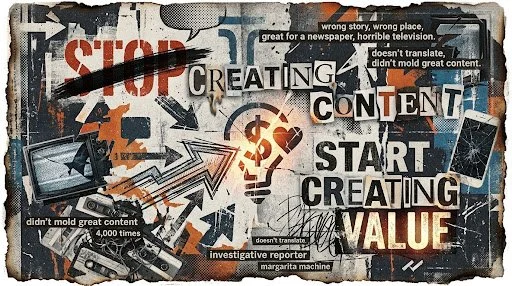
The most important story of the day is rarely the one people remember. Sometimes it's the wrong story, or sometimes it's in the wrong place.
I spent a long time in my journalism career trying to explain to others why content that is great for a newspaper is often horrible television, and why a great news story on TV often doesn't work on Facebook.
I'll never forget an amazing story we had about a woman at a local college who used the school credit card nearly 4,000 times to purchase items for herself, like a TV, football tickets, and a margarita machine. The story had all the elements, including the woman closing her garage door on our investigative reporter as she stood right next to, you guessed it, a very large margarita machine.
It was incredibly compelling television. It also flopped online. It just didn't translate as a story on a website, and in the early days of social media we didn't mold great content to fit the platforms we published on.
The wrong question every morning meeting asks
That wasn't a one-off. I watched some version of it play out more times than I can count in the newsroom. The pattern never really changed.
Most editorial morning meetings across the country ask some version of the same question: What's the most important story today? And every morning, that's the wrong question. The right one is: Why will anyone actually care about the most important story today? Those are not the same thing. The gap between them is where most content quietly dies.
You don't need to work in a newsroom to recognize that gap. Swap "editorial meeting" for a city council briefing, a nonprofit's board update, or a company's product launch, and the instinct is identical. Everyone in the room already believes it matters. That's usually why it made the agenda in the first place. The harder question is whether anyone outside that room will feel the same way, and most of the time, nobody in the room stops to ask.
I've seen this firsthand managing a team that produced 40 Facebook posts a day. Sometimes we'd change nothing about a story except the headline, and the readership would double. The story hadn't gotten more valuable overnight. We'd just finally told people, in about four words, why it was worth their next 90 seconds. The value was already there. We'd just buried it.
It’s not just a newsroom problem
And this isn't just a news problem, or even a private-sector one. Scroll for 30 seconds and you'll see it everywhere. Not long ago, I came across a car dealership's video of the whole staff spinning around in office chairs, right after a law firm's video that looked like a dance party. Both were clearly fun to make. I just couldn't tell you afterward why I'd pick either one over the shop or the firm down the street. Nonprofits and government agencies have their own version of this. A public safety campaign that's all mascot and no message. An annual impact report nobody opens past the cover page.
That's not really a platform problem. TikTok can be a strong platform for a law firm. The platform never asked anybody to spin in a chair. Usually what's missing is the answer to one question: What are we actually offering here that the other nine firms or dealerships nearby aren't?
Relevance gets someone to glance over. Value is the reason they stay.
That question is the secret to this content challenge, whether you're a company, a nonprofit, or a government agency. You're often one of roughly ten organizations doing something close enough to identical that nobody outside your building could tell the difference. Relevance gets someone to glance over. Value is the reason they stay.
It's a specific, honest answer to "Why us, and not the ten places that look just like us?" And you don't just state that value. You have to sell it, with emotion, not features. That's a quieter distinction, but it's the entire difference between content that gets scrolled past and content that gets a response.
Start with the idea, not the format
The short version is this: format only works once the story is right, and the platform only works once you know your audience. Don't start with "Let's make a video." Start with the strong idea that can carry a video.
The organizations that get this right aren't necessarily publishing more than everyone else. They're just more deliberate about what they put out, and why. And when they get it right, it shows. Their message lands, spreads, and does actual work. When it's wrong, it's a story about a giant margarita machine sitting in a garage that no one sees. You can't always fully explain why a story works and becomes viral. You just know it worked because you took the right steps.